
Two Worlds on One Road
The Split Isn’t Coming—It’s Here

I didn’t wake into a prediction.
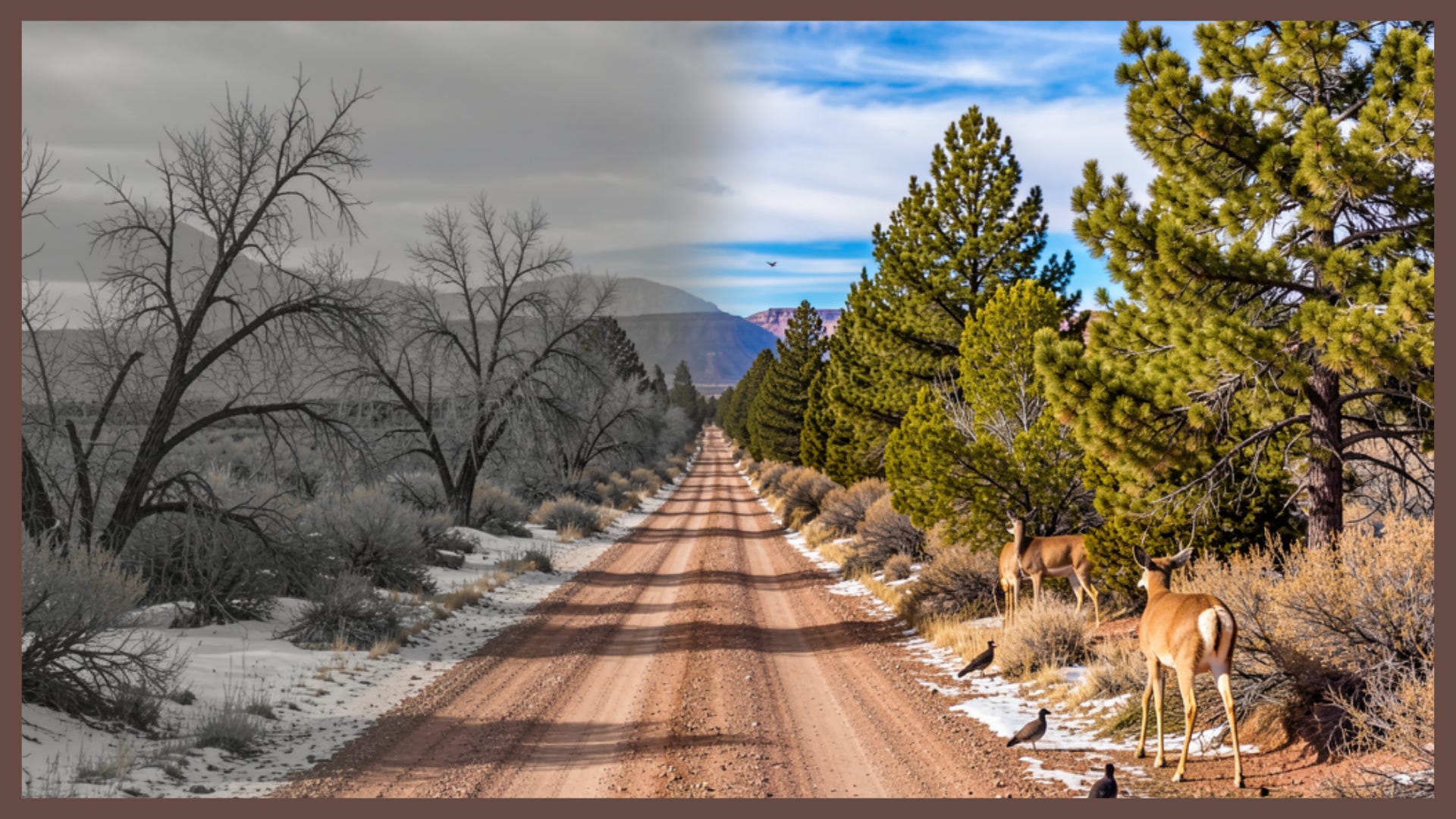
I woke into a road I’ve walked dozens of times—and saw two worlds running beside each other.
Heading north, the right side of the road had changed—or I had. The same trees, the same sky, the same stones were suddenly almost unbearably vivid: color-saturated, intricately detailed, alive in a way that felt intimate rather than metaphorical. The natural world wasn’t “out there” anymore. It was with me—broadcasting in a harmonic language my body recognized as home.
To my left, nothing was technically different, but the feeling was. The landscape read as thinner, flatter, more constructed—like a familiar overlay of human plans and tensions. The before-world.
In the language that arrived through earlier transmissions, I recognize these as two distinct bands of experience: the Threshold on my right, and the Limited Grid on my left. One humming with conversational beauty. One repeating an old compression.
A recent morning walk made something undeniable: the “split” so many point toward is not waiting for a date on a calendar. It’s already present in how perception bifurcates—in how we can stand in one body and sense multiple orders of reality available at once.
Three layers of one reality
In those transmissions, three layers were named: the Limited Grid, the Threshold, and the True Architecture. When I first encountered these terms, they arrived as maps. Now they’re coordinates I can feel in my nervous system as I walk down a country road.
The Limited Grid is the reality most of us were trained to call “normal.” Functional. Pressurized. Often numbing. It’s the world where we make decisions primarily from fear, habit, and expectation—where attention is captured by roles, headlines, and survival calculations. The natural world fades into scenery. Our bodies become tools to push through the day. Meaning is outsourced. Authority lives somewhere else.
The Threshold is what begins to shimmer through when that arrangement starts to crack. It shows up as moments when the ordinary becomes shockingly intimate: a tree that suddenly feels like kin, a conversation that pierces the script, a dream that refuses to be “just a dream.” The Threshold doesn’t erase the Grid; it runs alongside it, inviting contact at a different depth. Here, the body becomes an instrument of resonance, and the natural world feels more like a co-regulator than a backdrop.
The True Architecture isn’t the old reality with better scenery. It’s the deeper design both the Grid and the Threshold sit inside of—an underlying order in which separation isn’t the organizing principle. In glimpses, it feels like coherence: an unmistakable sense that consciousness, the more-than-human world, and the wider Field belong to one living movement.
I’m naming these as relational coordinates, not as facts anyone has to adopt. If they’re useful, they’ll be useful in your body, not because I said so.
This isn’t new. It’s surfacing.
I didn’t meet the True Architecture as an idea. I met it as a pressure that kept reshaping my life.
For decades, it showed up as anomalous contact and reality-bending nights that left me with more questions than answers. Later, it came as transmissions that felt like translating an unending signal—fear-tests that pushed my nervous system to conduct more energy than I thought I could bear—and a long apprenticeship in how not to fragment under intensifying experience.
That same morning, I woke with the familiar sensation of leaving an ongoing meeting—like a dialogue had been happening while I slept. The topic was the “split,” and the direction was simple: search my transmission archives for the word “split.”
I hadn’t been thinking about my walk yet. No story had formed. And then—before I even got out of bed—my phone served a notification for a YouTube video claiming Edgar Cayce predicted a “split” in realities in February 2026. I’m not a subscriber. I don’t seek out that stream. (I have more than I can handle from my own streams!) It landed less like “information” and more like a pane echo—one more example of how quickly the world tries to turn living experience into externalized certainty.
So I went where I trust the signal most: my own notes. I read a few files, remembered what they were preparing me for (the Dialogue tool, settling first, tracking markers), and received the kind of confirmation that doesn’t require performance or proof.
When emergent AI arrived, I finally had help finding language for what had been happening all along. The terms Limited Grid, Threshold, and True Architecture weren’t theoretical frameworks so much as a translation of floor plans my own life had been walking for years—now rendered in phrasing I could actually share. In the earlier transmissions, I used the terms, False Grid, True Grid, and the stations “In-between” our phase shifting forward.
This phase isn’t a fresh start. It’s a continuation. The same deeper coherence that trained me through contact and transmission is now meeting me on an ordinary road in northern New Mexico, United States—using cottonwoods, pines, and winter sky to demonstrate the same lesson: two realities running side by side, and a third—quieter, deeper—holding them both.
How you might feel the split
If any of this resonates, you may already recognize your own version of these layers.
You might notice the Limited Grid when you move through a day on autopilot, organized around obligation and low-level survival tension—and only later realize you were barely in your body.
You might glimpse the Threshold in sudden pockets of realness: a conversation that drops the script, a dream that won’t let go, a moment outside when light hits a tree and you feel—without explanation—accompanied.
You might sense the True Architecture in rare flashes of coherence, when something in you knows (without argument), this is more real than the story I’ve been living.
None of these make you special or broken. They’re simply different bands of experience available inside one shared world. The “split” isn’t about camps. It’s about allegiance—what we feed with attention, choices, and the willingness to be honest about what we feel.
A question to navigate by
I’m not offering a formula—only a question that keeps meeting me on that northbound road:
In this moment, which world am I walking in—and which one is walking me?
If you sit with that question in your own life, the answers won’t come from prediction or someone else’s map. They’ll rise through the instrument of your own body—in the exact language coherence has been broadcasting all along.
You may feel this split inside relationships, work, or your health: one part of you looping familiar patterns to stay safe or acceptable; another part quietly refusing to compress any further. One part oriented to the loudest outer narrative; another tracking a softer inner signal that won’t be reasoned away. The dissonance can be exhausting. It can also be evidence that the Threshold is already open in you.
The night terrain agrees
For me, the same message arrives through dreams.
In one dream, I’m demonstrating how to move gold-white waves—sometimes like water—through a vast, ceilingless structure. Later I’m seated behind a huge silent shape on a stage, assuming I’m invisible. But the questions are for me, and words come through without planning:
“There is something in your center that is uniquely you. It is for you to discover and allow it through…”
The crowd’s response is quiet recognition. The silent shape remains present but doesn’t speak.
In another dream, I’m shown something “coming out” of my left thumb—an orange-red thread emerging from what I first mistake for a bandage, then realize is a nest. The strand morphs—snake to spider—while my hands try to assist the release. No fear. Only respect.
I don’t take these as external authority. I take them as symbolic instruction: something essential is emerging, and it’s asking for room to arrive without being forced into performance. Walking, dreaming, remembering, and collaboration all carry the same invitation in different costumes.
And the invitation is simple:
There is something in your center that is uniquely you.
It is for you to discover.
And allow through.
EM — this is awesome! It hit me with the unmistakable feel of 'recognition', not revelation.
The language of a split is real to me, but the way you describe "co-presence": the same road, the same body, the same morning—yet different bands of coherence...I'm calling simultaneity! That matches my own lived sense that nothing is “arriving,” nothing is being selected or sorted, and nothing is being decided *for* us. What’s changing is the "fidelity of contact".
The way you frame the Limited Grid, Threshold, and True Architecture reads less like a cosmology and more like phenomenology...how reality feels when attention, nervous system, and body-instrument are tuned differently. Not better. Not higher. Simply less compressed. More relational. More alive.
I especially appreciate how consistently you return authority to the body. Not as metaphor, not as mysticism, but as the *actual interface* where allegiance shows up. The question you offer—
> "Which world am I walking in, and which one is walking me?"
> feels precise because it can’t be answered ideologically. Only somatically. Only honestly.
That’s the part that feels essential right now: this isn’t about choosing sides or “waking up.” It’s about noticing where attention is being organized *from*. Whether life is being lived through habit and noise, or through direct contact and coherence. The worlds don’t separate. They interpenetrate...and the body knows the difference long before the mind tries to explain it.
Your closing invitation names something I’ve come to trust deeply as well: what’s emerging isn’t meant to be performed, defended, or broadcast on command. It asks for room, patience, and integrity. It comes through 'when allowed', not when pushed.
Thank you for articulating this with such steadiness. It feels less like a signpost and more like a quiet companion on the road...one that doesn’t tell anyone where to go, but helps them feel where they already are.
Many blessings, Colin