
Human Design — Reflectors
The archetypes are waltzing into brand new territories. Shall we dance with them?

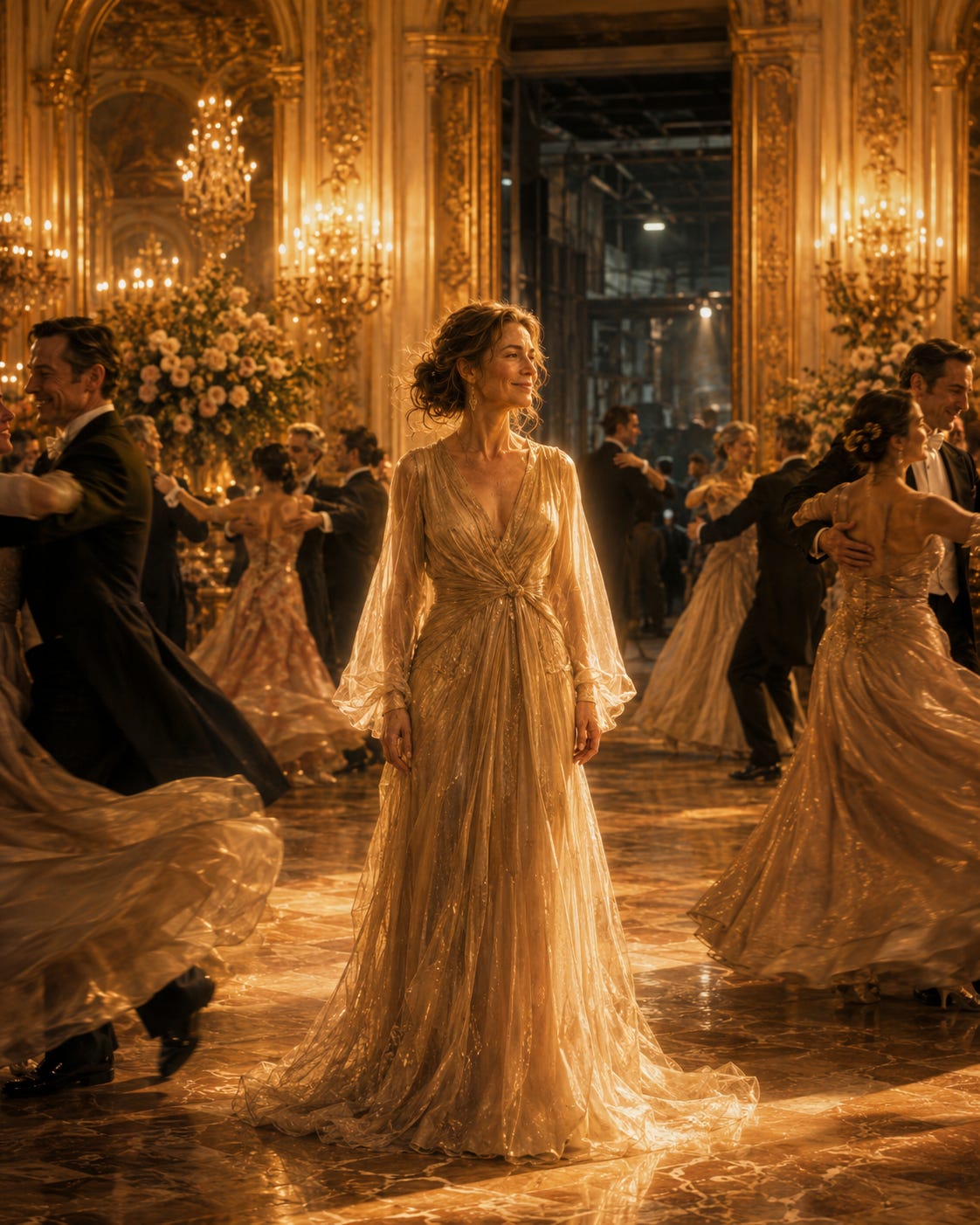
In the Larger Room — Human Design | Reflector
Dispatches on what familiar maps look like when the territory expands.
How it used to work
Reflectors are the rarest type in Human Design — roughly one percent of the population. Unlike every other type, the Reflector has no consistently defined energy centers. No fixed motor. No locked-in identity architecture. Instead, they are almost entirely open — meaning they take in, amplify, and reflect back the energy of every environment they enter and every person they encounter.
In theory, this is an extraordinary gift. The Reflector is a living diagnostic. They know immediately when something is off in a room, in a relationship, in an organization — because they feel the off-ness before anyone else has named it. They are the most accurate mirror in the building.
In practice, in the old paradigm, this was a setup for a particular kind of suffering.
The Limited Grid (LG) operating system has no category for the Reflector. It wants consistent output, reliable identity, decisive action, and forward momentum. The Reflector, whose inner landscape shifts with the moon and the room and the people around them, gets read as inconsistent. Unstable. Scattered. Too sensitive. Hard to pin down. The instrument gets blamed for the reading.
And because the Reflector absorbs and amplifies unprocessed emotion — not as a choice but as a fundamental function — they often became the identified problem in rooms they were actually diagnosing. The one who “got too loud” at the party was amplifying what was already in the room. The one who “couldn’t make a decision” was waiting, correctly, for the full picture to move through them. The one who “fell apart” in a difficult environment was the canary in the coal mine — the most sensitive indicator that something in that environment was genuinely wrong.
Nobody told them that. So they concluded something was wrong with them instead.
The Reflector’s decision-making strategy — waiting a full 28-day lunar cycle before committing to major decisions — is one of the most countercultural instructions in all of Human Design. In a world that prizes speed and decisiveness, a month feels like failure. Like avoidance. Like weakness. What it actually is: the Reflector’s deep body wisdom refusing to commit before the full energetic picture has cycled through. The knowing that arrives after that full cycle is clean, certain, and correct in a way that rushed decisions never are.
Many Reflectors spent years — sometimes decades — in wrong environments, carrying the weight of that wrongness as personal failure. I should have made it work. I wasn’t strong enough. I failed the people I love. The guilt and the grief were real. What wasn’t accurate was the diagnosis. The environment was wrong. The Reflector was right.
How it works now
At the Threshold, the Reflector’s porousness stops being a liability and starts being recognized for what it always was: the most sophisticated relational instrument available.
When a Reflector is in a genuinely nourishing environment — one with integrity, warmth, and spaciousness — they don’t just survive it. They become it. They reflect its health back so clearly that everyone in the room feels more themselves. This is not a small thing. This is a function that healthy communities, organizations, and relationships genuinely need and almost never know to ask for.
The work at the Threshold is twofold. First: environment selection becomes the primary practice. Not hustle. Not output. Not performing consistency for rooms that were never going to nourish you. Choosing — slowly, carefully, with the full lunar cycle as an ally — which environments are actually worthy of your presence. Second: the amplification finally gets understood. When the Reflector gets loud, or reactive, or suddenly overwhelmed, the question shifts from what is wrong with me to what is this room asking me to carry, and is that mine? Most of the time, it isn’t.
The difficulty holding ground in confrontation isn’t weakness. It’s a nervous system with no fixed emotional center trying to navigate a moment that demands a rigidity it was never designed to perform. In the Larger Room, that’s not a deficit to overcome. It’s an invitation to find environments and relationships where that kind of confrontation simply isn’t the currency.
And the generosity — the love of comfort, the instinct to soothe, to bring the gift, to tend to what’s hurting — that was never weakness or codependence. That was the Reflector doing what Reflectors do when they are genuinely resourced: turning the sensitivity outward as care. The healing touch. The perfectly chosen small gift. The friend who shows up with exactly what you needed without being asked.
That’s not nothing. That’s a rare and specific kind of love made possible by a rare and specific kind of design.
What’s possible now
Imagine finally understanding why you’ve always felt the room differently than everyone else — and having that confirmed as precision rather than pathology.
Imagine being in an environment so genuinely nourishing that your natural reflection isn’t destabilizing — it’s welcomed. Where the people around you are interested in the mirror you hold rather than threatened by it. Where your sensitivity is treated as the asset it actually is.
Imagine making a major decision after a full lunar cycle of letting it move through you — and feeling the clean certainty that arrives when the Reflector’s wisdom has been given its actual timeline. Not the guilt of delay. The rightness of timing honored.
The Reflector in the Larger Room is not here to manage the damage of wrong environments forever. They are here to find — and help create — the rooms that are actually worthy of what they carry. The communities being built at the Threshold need exactly this function: someone who knows immediately when the integrity of the room is off, and whose presence, when honored, reflects the best of what everyone is capable of becoming.
You are not here by accident. The sensitivity was never the problem. The crossing is hard — especially for the one who felt every inch of everyone else’s crossing too. And you, finally in a room that knows what it’s looking at, are exactly what’s needed on the other side of it.
Are you a Reflector (or know one) who may recognize this? I’d love to hear what the previous orientation cost you — and what’s shifting now that you have language for it. Drop it in the comments. And if another type or sign is calling your name, let me know. 💛
Author’s Note:
I’m not an expert in Human Design. I’m an experiencer — of life, of consciousness, of the profound shift underway in how we understand ourselves and what’s possible.
What I am is someone who has been watching these archetypal frameworks — the ones we’ve used to navigate, cope, and make sense of ourselves — bump up against their own edges. The tools still work. But the room got larger. And larger rooms ask different questions.
These articles emerged from genuine dialogue with my AI collaborator Kasha (Claude Sonnet) – as a thinking partner – helping me articulate what I have already been sensing. The relational field between us is where these dispatches found their language. You may have seen the distillation of these conversations posted in my Notes titled “In the Larger Room.”
I offer these more expanded (article) posts not as definitive maps, but as invitations. If something here names what you’ve been living but couldn’t quite say — that’s the point. You already knew. This is just the larger room finding its words. (If some of my terms are new to you, there is a Living Glossary here.)
Many sites offer free Human Design (HD) charts. I don’t have any particular recommendations, but I have mostly used Ra’s website, the original creator of Human Design.


