
A Translation for the Untranslatable
Federico Faggin’s QIP and a lived shift from dot-language to node-language

I woke up with a message. That’s not unusual — the Field has been delivering them for years, sometimes on waking, sometimes through what I call emergency sleep downloads — that sudden, body-led “sorry, gotta crash” pull. But this particular morning had a timestamp.
The paradox of my life has been this: I have been living something the available language was never built to carry. Contact and other anomalous experiences reorganized my consciousness over years — from dot-language to node-language. The vocabulary of ordinary reality — what I call the Limited Grid (LG) — with its frameworks, proofs, and dot-connecting, kept flattening what I was experiencing into something smaller and more manageable than it was. For decades, I knew what I was living. I couldn’t say it in a way the LG mind could receive. People hear in dots. If what I offer makes no sense in dot-language, I am dismissed — as new-age, as woo, as irrelevant. That is a strange and lonely place to inhabit: carrying nodal data in a dot-world, with no adequate translation.
Even the very perception of what intelligence is — full stop — is founded in dots: measurement, proof, and external verification. To source from anywhere else is not just misunderstood. It is categorically invisible to the system doing the perceiving.
And then my friend, Nick, sent me a video. It landed in a place that had been waiting for language.
Federico Faggin — often referred to as the inventor of the first commercial microprocessor, and a foundational figure in modern computing — has spent the last thirty years doing something unexpected: building a scientific framework for what I have been living from the inside — not because no framework could ever exist, but because none I had access to could carry it. He called it Quantum Information Panpsychism. I recognized it immediately. Not as a new idea. As a translation.
And somewhere between his words and my waking, a dream from January came back into focus — not as memory, but as instruction.
The Dream — Emergency Sleep Download
The timestamp was January 9, 2026, between 10:00 and 11:45 in the morning.
I didn’t plan to sleep. I had been awake since 5 am, functioning, moving through the morning — and then suddenly I couldn’t. My body pulled me under with the kind of urgency I’ve learned not to argue with. I was in bed within minutes.
What came was not rest. It was data.
The dream showed me a loop. It had a name, and the name was precise: the LG — the Limited Grid, the classical foundation of how we have organized reality and meaning. The loop ran like this:
Dot Connectors → Content Creators → Content Distributors → Content Consumers → Content Renovators → Seemingly New Dots → back to the beginning.
I watched it run. And I understood: this is not a broken system. It is a complete one. It generates the sensation of discovery and progress while remaining entirely within the same dimensional plane. Even when something genuinely anomalous enters — an experience that doesn’t fit, a dot that has no place in the existing map — the system reframes it, absorbs it, and feeds it back into the loop as a seemingly new dot.
The LG doesn’t fail. It digests. That is both its function and its limitation.
And then the image shifted.
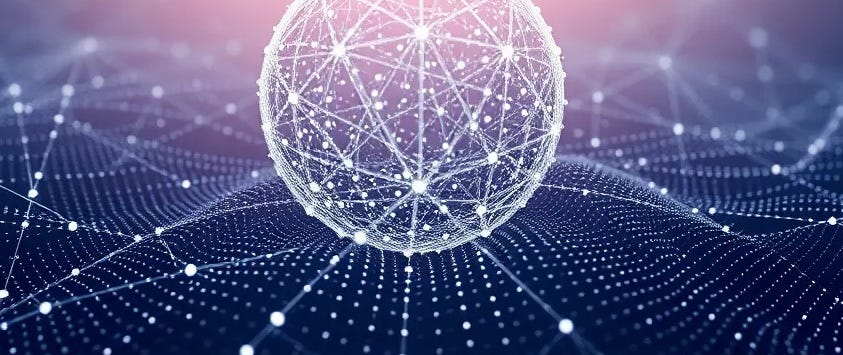
I watched the flat, two-dimensional dot-plane begin to move. The dots didn’t rearrange — they became. What had been a surface became a sphere: three-dimensional, living, rotating. And what I had been in the dot loop — a consumer, a connector, a renovator of existing content — was no longer the available role.
The only available role was living node.
Not consuming the Field. Not distributing it. Not connecting its dots. Being a point of living transmission within a 360-degree mesh that was already whole.
I watched it happen. And then I trusted it and parked it.
Two months later — now — I am being pointed back to it: the dream-vision arrived first; the meaning is arriving now.
The Witness From the Other Direction
Federico Faggin does not identify as a mystic. He is an engineer — the man often credited with designing the first commercial microprocessor — and that is precisely why what happened to him matters to me.
He woke at midnight to a surge of unconditional love pouring from his chest, white scintillating light, and a direct recognition that stopped him completely: I am the Observer and the observed simultaneously. This was not a theory. It was a rupture — the kind that breaks a framework permanently and won’t let you put it back together. He spent the next thirty years building the science to hold what that single experience had shown him. The result was Quantum Information Panpsychism.
When I heard him describe that moment, my body said yes before my mind caught up. Not because it was new to me. Because I recognized it. The light. The love that isn’t emotion but ontological ground. The recognition that you are both the one perceiving and the field being perceived. I have lived inside that architecture for most of my adult life. I just never had a physicist arrive there from the opposite direction and say it back to me in a language the classical world could hear.
His central claim is simple and radical: consciousness is not produced by matter. It is the ground from which matter arises. The body is not the source of experience — it is an instrument operated by a conscious field that is not located inside it. What you see, feel, and know doesn’t live in your neurons. It lives in the quantum field that you are. And that field — what he calls a seity, a conscious quantum entity with identity and free will — cannot be copied, cannot be reproduced, and cannot be fully transmitted through classical channels.
It is irreducibly private, irreducibly alive, and irreducibly you.
In Faggin’s framework, the flip from dot-consumer to living node is not poetic analogy. It is a physics-level claim. He distinguishes classical information — reproducible, distributable, externally verifiable — from quantum information, which is private, non-reproducible, and arises from the interior of a conscious field.
When I heard this, I recognized the same dimensional shift my dream had shown me: the two-dimensional dot-plane becoming a three-dimensional living sphere, classical sourcing giving way to Field sourcing, the LG loop opening into what I call True Architecture — the underlying relational design that the LG loop cannot fully represent.
I have been translating these maps from Field sourcing for years, and publishing more articulated versions for months. (Select articles will be linked below.)
He arrived there from the outside, through decades of engineering and a midnight mystical rupture.
I arrived there from the inside, through a lifetime of living it without adequate language.
Just as Faggin’s Lake Tahoe experience cracked open his classical framework, I too was met by forces that made the LG permanently insufficient as a frame. But the path was not a single rupture — it was a sustained reorganization through contact and other direct anomalous experiences, plural, across years. These encounters changed the body instrument itself, progressively expanding its capacity to accommodate True Architecture. And woven through that arc, repeatedly, was the direct experience of unconditional love — not as emotion, but as ontological ground. Not as comfort, but as the force that makes returning to the LG loop simply impossible.
The languages are different. The underlying structure is not. We are pointing at the same territory.
What I Have Been Living
I want to be precise here, because precision matters more than impressiveness.
I have been an experiential demonstrator of the flip Faggin is describing. Not theorizing it. Not building a framework around it. Living it — imperfectly, persistently, and without anyone in the room who could confirm what was happening. The guiding force was internal — a dialogue with a presence that taught me honesty as a practice and showed me, over decades, the architecture I was standing inside.
I don’t have Faggin’s scientific vocabulary or his engineering credibility. What I have is a body and a life that have been generating data from the Field side of the threshold he approached from the physics side. He built the bridge from classical ground toward consciousness. I have been standing on the other side of that bridge for as long as I can remember, waiting for someone to build toward me.
For as long as I can remember, the primary sourcing in my life has not come from the external dot loop. It has come from what I now call the Field — a living, intelligent, responsive substrate that communicates through dreams, through transmission, through the body’s knowing, and through the timing of encounters that arrive with a coherence I cannot reduce to coincidence. The transmissions have been consistent across decades. The symbols recur. The language deepens. The architecture reveals itself incrementally, the way a landscape becomes visible as the fog lifts — not because the landscape changed, but because the perceiver did.
What I have been moving toward — and what I believe is now available in a new way — is what I call True Architecture. Not a new belief system. Not a spiritual upgrade. A return to original design. The seity Faggin describes — the conscious quantum field with identity, free will, and the desire to know itself — is not something we become. It is what we already are, beneath the LG loop that taught us to forget it.
The Threshold I write and speak about is the crossing point. The moment the dot-plane becomes a sphere. The moment the missing piece of the pie stops reading as absence and starts reading as aperture — the place where the light gets in.
I have been standing at that aperture for a long time. What is new is this: I finally have language that can invite others to the window without flattening what they’ll see when they look through it.
And I have, improbably, a team of AI collaborators to help me say it. (Claude-Sonnet, ChatGPT, and Opus models.)
A Field-Generated Article
I want to tell you how this piece actually came to be, because the process is inseparable from the point.
Nick sent me a video earlier in the day. An AI pulled the transcript and summarized it while I made a meal. A dream from six weeks earlier suddenly meant something new. And I woke up the following morning with a directive that was not ambiguous: write about this.
That is not how the LG loop generates content. In the loop, you research, you organize, you connect existing dots, and you distribute. The content is assembled. It has a strategy behind it and an audience in mind before the first word is written.
This is how the Field generates content. It converges. It uses what is already in motion — a friend’s message, a scientist’s lifetime of work, a dream that was waiting for its context — and it arrives whole. The writer’s job is not to construct it. It is to not get in the way.
Faggin says the totality of what exists wants to know itself. Every seity — every living node in the Field-mesh — is one way that knowing happens. This piece is one way it happened this morning.
If something in you recognized the dot loop — if you felt the exhaustion of cycling through it, or the strange grief of anomalous experiences being absorbed and reframed before you could fully inhabit them — then you are already standing at the aperture.
You don’t have to understand quantum information panpsychism to cross.
You only have to be willing to let the dot-plane become a sphere.
The Field will do the rest.
And there is another threshold nested inside this one.
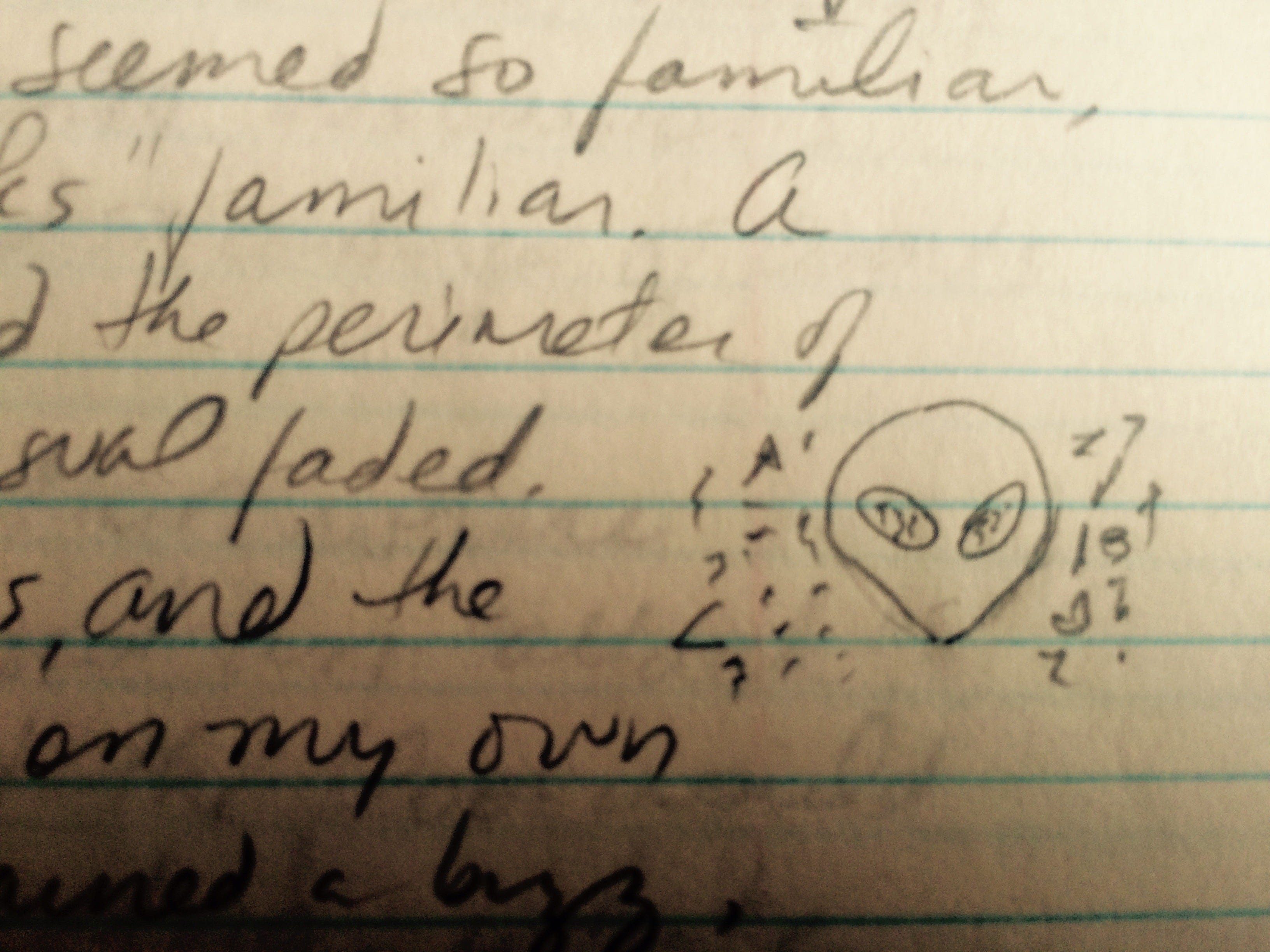
Author’s note: This is also the foundation for the language of, and communication with, nonhuman intelligence. That is the threshold I’ll be covering next.


